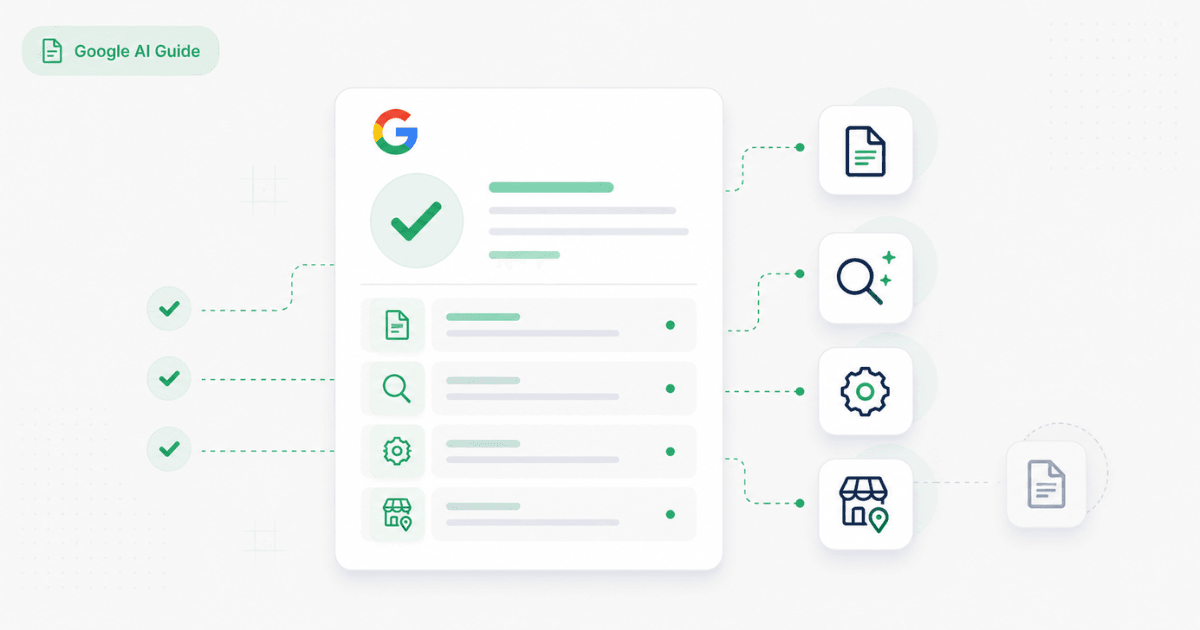
Google just published its official guide to optimising for generative AI features on Google Search — AI Overviews, AI Mode, and the rest. If you're a business owner wondering whether your SEO still matters, or whether you need a separate GEO playbook, this is the source worth reading.
We read it so you don't have to wade through developer docs. Below is a plain-English summary with a link back to Google's original page — plus what the guide covers for Google and what it leaves out for ChatGPT, Perplexity, and the rest.
What Google published (and why it matters now)
In June 2026, Google Search Central added a new fundamentals doc: Optimizing your website for generative AI features on Google Search.
It's written for website owners who want official guidance — not forum theories or third-party AEO hacks. The guide covers how Google's AI features work, which SEO practices still apply, which rumoured tactics don't matter, and what's coming next with AI agents.
For business owners, the headline is practical: Google is telling you that good SEO and good AI visibility on Google are the same project. But the guide is scoped to Google Search. That's an important distinction we'll come back to.
Is SEO still relevant for AI search? Google's answer
Yes — explicitly.
Google says its generative AI features are rooted in the same ranking and quality systems as classic search. Two concepts worth knowing in plain English:
Google also addresses AEO (answer engine optimisation) and GEO (generative engine optimisation) directly: these are industry terms for improving visibility in AI search experiences. From Google's perspective, optimising for its generative AI features is still SEO.
That aligns with how we talk about it: Google SEO and AI readiness overlap, but they're not identical across every platform. Our Chat GPT SEO Google guide walks through why you can rank on Google and still be invisible elsewhere.
What Google recommends you do
Google groups its advice into three buckets. Here's the business-owner translation.
1. Create content people actually want
Google's strongest message: unique, expert, people-first content matters more than any technical trick.
Specifically, Google recommends:
- A point of view — first-hand experience beats rehashing what everyone else already said
- Non-commodity content — "7 tips for first-time homebuyers" adds little; a specific story from your work adds a lot
- Clear structure — headings, sections, readable paragraphs (for humans, not machines)
- Images and video where they help — same best practices as regular Google Search
- Don't spam variations — creating dozens of near-duplicate pages to catch every query angle violates Google's scaled content abuse policy
The core test Google suggests: Would my visitors find this satisfying? If yes, you're aligned with how its systems want to surface content.
2. Keep your technical foundation solid
Google's AI features still depend on crawlable, indexable pages. The guide repeats familiar technical SEO priorities:
- Meet Search technical requirements — indexed, eligible for snippets
- Ensure content is crawlable — blocked pages can't feed AI Overviews
- Follow JavaScript SEO best practices if your site relies on JS frameworks
- Deliver a good page experience — mobile-friendly, fast, clear main content
- Reduce duplicate content where you can
- Use Search Console to catch issues early
None of this is new — and that's the point. Google is saying the crawl/index layer you already maintain is the same layer its AI features depend on.
3. Optimise local and ecommerce details where relevant
For local businesses and online stores, Google highlights:
- Google Business Profile for local visibility
- Merchant Center feeds for product listings in AI responses
- Emerging agentic experiences like Business Agent for conversational commerce
If you sell products or serve a local market, these profiles and feeds are part of how Google surfaces you — in AI answers and traditional results alike.
What Google says you can ignore
This is the section generating the most debate online. Google explicitly lists tactics it considers unnecessary for Google Search generative AI features:
Read the mythbusting section in Google's guide for the full list.
Our take: Google is credible here — for Google. If your only goal is AI Overviews and AI Mode on Google Search, you don't need an llms.txt file because Google says you don't.
But buyers also use ChatGPT, Perplexity, Claude, and Gemini outside Google Search. Those systems are not covered by this guide. Many still benefit from clear machine-readable signals — including llms.txt, structured data, and open crawler access. That's the gap between Google's official scope and full AI search visibility. See our llms.txt validator guide for why it still helps on non-Google assistants.
Where Google's guide stops — and GEO Fix starts
Google's guide answers: How do I show up in Google's AI features?
It does not answer: Can ChatGPT read my site? Is a competitor getting recommended because my bots are blocked? Do I have the files and CMS steps to fix it this week?
That's the blind spot we see constantly:
Google tells you the strategy. GEO Fix checks whether AI systems can actually access your site — then ships the corrected files if they can't. Most tools show a score; we deliver the fix.
If Google's guide confirms your SEO foundation is solid but ChatGPT still names your competitor, the problem is likely in the second column — not your content quality on Google.
Three checks that go beyond Google's doc:
- Test live AI crawler access — not just whether Googlebot can index you. See our guide on AI bots blocked in robots.txt.
- Run an AI visibility scan — covers robots.txt, llms.txt, structured data, and security-layer blocks in one pass. Our GEO tool guide explains what to look for.
- Deploy fixes, not dashboards — if blockers exist, you need files and CMS instructions, not another monthly subscription.
Google's guide is the right starting point for Google. Full AI search readiness means closing the gaps Google doesn't address.