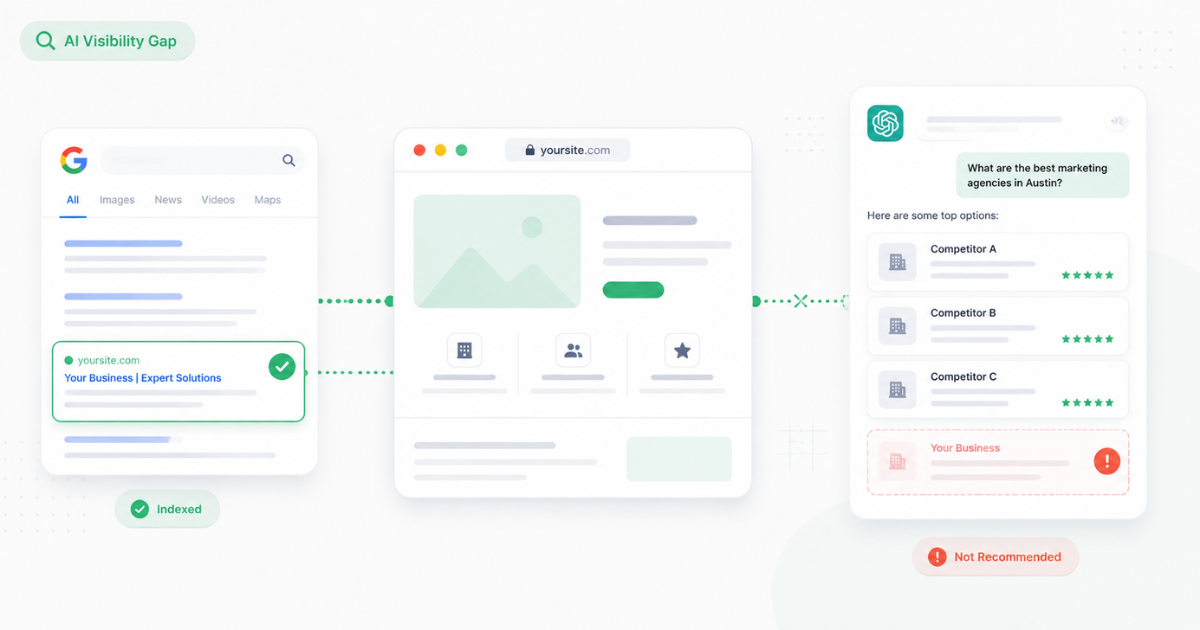
Traditional SEO tools — platforms like Ahrefs, Semrush, Moz, and Screaming Frog — were designed for one channel: Google search.
They help you answer questions like:
- Which keywords am I ranking for?
- Who is linking to my site?
- Are my pages fast, mobile-friendly, and crawlable by Google?
- How does my content compare to competitors in search results?
That's valuable work. For most businesses, it's still the foundation of online discovery. Google's own AI optimization guide confirms that good SEO remains the starting point for AI Overviews on Google Search — we broke down what that means for owners in our Google AI optimization guide summary.
But here's the gap: traditional SEO tools measure success in clicks from ranked links. They weren't built to answer a different question buyers now ask every day: "ChatGPT, who should I hire?"
That question runs on a separate set of signals — and most classic SEO dashboards never look at them.
Example: A marketing agency runs a full Ahrefs site audit. Page speed: green. Broken links: none. Core keywords: page one. The owner assumes the site is healthy. A week later, a prospect says they built a shortlist from ChatGPT — and the agency wasn't on it. The Ahrefs report never flagged the problem because Ahrefs wasn't checking whether AI could read the site at all.
A GEO tool — also called Generative Engine Optimization software, an AI visibility tool, or an AI search optimization tool — checks whether AI assistants like ChatGPT, Perplexity, and Gemini can find, understand, and cite your business. Some ChatGPT SEO tools focus on citation tracking; others on technical readiness. The category is still forming, but the core job is the same: can AI recommend you?
In plain English, it answers:
- Can AI readers actually reach your website, or is something blocking them?
- Does your site give AI clear, machine-readable facts about who you are and what you offer?
- Are you set up to be recommended — or accidentally locked out?
That's a different checklist from keyword rankings. A useful AI discoverability tool typically looks at:
- AI crawler access — whether the automated visitors AI companies use to read sites (like GPTBot) are allowed in, or blocked by your security layer
- robots.txt for AI bots — the simple instruction file that tells bots what they may read; one wrong line can shut AI out while Google keeps working
- llms.txt — a short about us file for AI at yoursite.com/llms.txt
- Structured data — clear labels on your pages so machines understand your business, services, and location
- Security-layer blocks — whether Cloudflare or similar tools are treating trusted AI readers like bad bots
Most traditional SEO crawlers check whether Googlebot can reach your pages. They don't always test whether AI-specific crawlers can — and that's exactly where the green SEO report, invisible to AI pattern hides.
Example — the split in one scan:
Result: Google rankings unaffected. ChatGPT cannot read the site. The SEO tool says everything is fine. The GEO tool shows why AI keeps naming competitors instead.
Example — missing context, not missing content: A Shopify store ranks well for its product category. Pages are indexed. Content is solid. But there's no llms.txt file and no structured data describing the brand, location, or product range. A buyer asks Perplexity for recommendations in that category — and gets three stores with clearer machine-readable profiles. The store isn't blocked. It's just harder for AI to parse than the alternatives. An AI citation tracking tool might show the gap in mentions over time; a readiness scan shows the missing files to fix.
Why strong SEO doesn't guarantee AI visibility
This isn't a hypothetical future trend. G2's 2025 survey of 1,000+ B2B software buyers found half now start vendor research in an AI chatbot instead of Google Search — a 71% jump in just four months. That means your next prospect may never visit your site before deciding who to talk to. If AI can't read or recommend you, you're out of the shortlist before the conversation starts.
The channels overlap — most buyers still use Google at some point in the same decision — but they don't share identical rules. Google SEO and ChatGPT visibility run on different crawlers, different retrieval systems, and different success metrics. Our Chat GPT SEO Google guide walks through why you can rank well on one and still be skipped on the other.
Some legacy SEO platforms now offer AI visibility modules — brand mention tracking, AI Overview appearance, citation share. That's useful monitoring. But adding a GEO tab to an SEO dashboard doesn't automatically check whether your robots.txt is blocking the crawlers ChatGPT uses for live recommendations, or whether your llms.txt file exists at all.
That's the gap geo tools vs traditional seo tools comparisons are really about: not replacing your SEO stack, but covering a blind spot it was never designed to see.
Neither replaces the other. Strong Google SEO helps AI visibility on Google-owned surfaces. It doesn't automatically mean ChatGPT, Perplexity, or Gemini can reach and interpret your site. You need both channels open — especially when high-intent B2B buyers are building vendor shortlists in AI before they ever click a search result.
The GEO software landscape: who does what
Once you accept that SEO tools and GEO tools solve different problems, the next question is usually: "Okay — which GEO tool?"
The category is young, but it's not empty. Generative Engine Optimization tools already split into distinct approaches. None of them replace Ahrefs or Semrush for keyword research — and none of them do exactly the same thing as each other either.
Most AI citation tracking tools and monitoring platforms excel at answering: "Are we being mentioned?" That's valuable for teams with budget for ongoing dashboards and someone to act on the data.
They typically don't generate a corrected robots.txt, an llms.txt file, or structured data you can paste into WordPress or Shopify. If your problem is technical — blocked crawlers, missing files, no machine-readable business facts — you need a different type of GEO software entirely.
That's not a knock on monitoring tools. It's a category distinction. Know which problem you're solving before you buy.
GEO tools generally fall into two categories: monitoring tools that track AI mentions over time, and implementation-focused tools that scan for technical gaps and help you close them.
Traditional SEO tools almost always stop at insight: here's your score, here's what's wrong, here's a report. You (or your agency) implement the fixes. Most AI visibility tools in the monitoring camp work the same way — useful dashboards, but the deployment is still on you.
Implementation-focused GEO tools add a second step: the scan plus the actual files and CMS steps to close gaps.
GEO Fix is an example of the second category — one of several AI search optimization tools on the market, but built specifically for owners who want files shipped, not another monthly dashboard. It generates corrected robots.txt, llms.txt, and structured data, plus copy-paste steps for WordPress, Shopify, Wix, and Webflow. One-time payment ($199 Starter, $399 Pro), no monthly subscription. For a full cost comparison across approaches, see our GEO pricing guide.
Honest limit: no tool — SEO or GEO — can guarantee you'll appear in ChatGPT next week. Platforms control citations. What you can control is whether AI systems are blocked from reading your site and whether your pages give them enough structure to understand your business.
If you're starting from scratch, here's a simple decision path:
- Already paying for Ahrefs or Semrush? Keep it for keywords and backlinks. Add a GEO scan to check the AI blind spot your SEO tool wasn't built to see.
- SEO report is green but AI skips you? Start with a free AI readiness scan — not another keyword audit. The problem is usually crawler access or missing machine-readable files, not content quality.
- Just want to know if ChatGPT can see you? Run an Express Check before buying anything. It takes about a minute and covers the signals SEO dashboards miss.
- Need ongoing rank tracking? That's SEO tool territory. Need files deployed so AI can read you? That's GEO tool territory.
The fastest honest path for most founders and marketing owners: scan first, then fix only what matters — without replacing a tool that's already working for Google.
For a deeper look at what a GEO scan should cover, see our guide to checking if AI can find your business. If bot blocks are the issue, our AI bots and robots.txt guide explains which crawlers matter for recommendations vs. training.