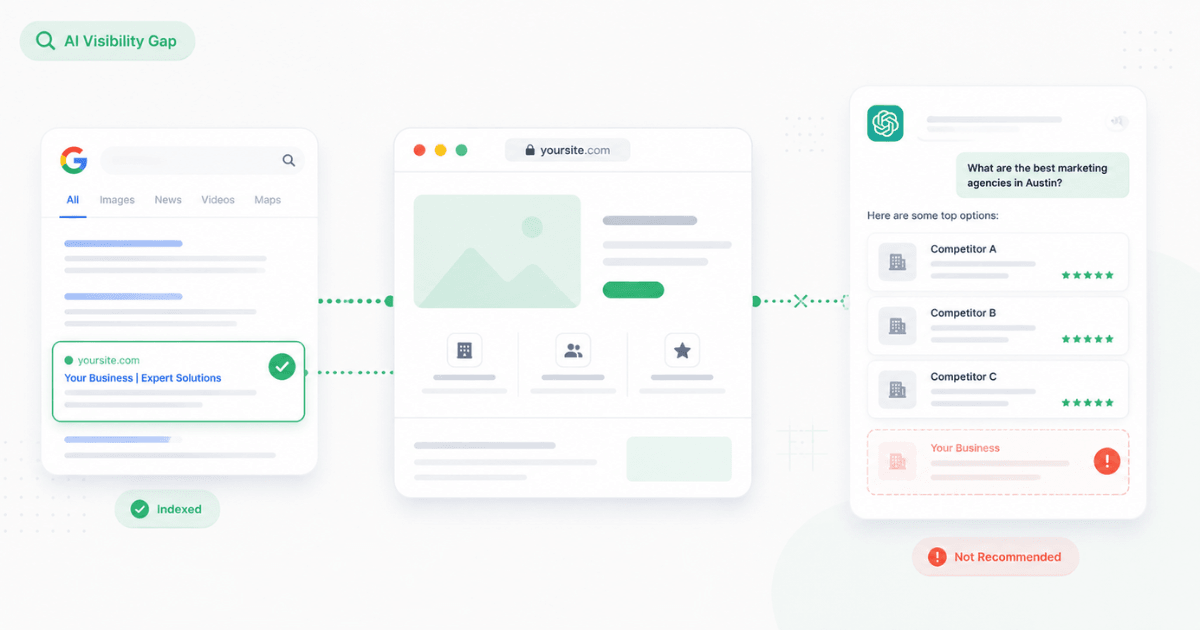
A buyer asks ChatGPT for the best company in your category. Three competitors appear. Your business doesn’t.
Your Google rankings are fine. Your SEO report still looks green. Traffic still arrives. But AI recommendation visibility runs on a different set of rules than classic search — and most owners don’t discover the gap until a deal is already lost.
People search chat gpt seo google when they rank on Google but ChatGPT skips them. This post explains why — and what to check first.
Google SEO and ChatGPT visibility are not the same thing
When owners ask I rank on Google — why doesn’t ChatGPT know about us? they’re usually hitting one confusion: Google search and ChatGPT recommendations overlap, but they’re not the same system.
Channel
What it focuses on
What success looks like
Google SEO
Search rankings, clicks, indexed pages
You appear in results and AI Overviews when someone searches
ChatGPT / AI assistants
Whether AI can read, understand, and cite your site
You get named when someone asks for a recommendation
You can score well on one and poorly on the other. That’s the green SEO report, invisible to AI pattern. Owners know Google is working. They’re not sure AI is.
A common pattern makes this concrete: a professional services firm ranks on page one for its core keywords. A prospect later says they shortlisted three vendors from ChatGPT — and the firm wasn’t one of them. Nothing in Google Search Console flagged a problem. Rankings were stable. The issue wasn’t the offer. It was that AI readers couldn’t reach or interpret the site clearly enough to recommend it.
What Google Overview shows vs. what ChatGPT recommends
Google Overview (formerly AI Overviews) pulls from pages Google already indexes and trusts. If your classic SEO is solid — crawlable pages, good content, reasonable authority — you have a fair shot at appearing there.
ChatGPT works differently. It relies on its own crawlers and retrieval systems to read the live web. A page Google indexes fine can still be blocked, thin on machine-readable facts, or missing the files AI systems use to orient quickly.
That split matters for business owners because buyers don’t stick to one channel:
Some start on Google and see an Overview summary.
Others open ChatGPT and ask, "Who are the best [category] companies in [city]?"
Many do both in the same decision — but the starting point is shifting. According to G2's 2025 survey of 1,000+ B2B software buyers, half now start research in an AI chatbot instead of Google Search — a 71% jump in just four months.
This isn’t an either/or choice. It’s two doors into the same buying journey — and you need both open.
Why strong Google SEO can still mean weak ChatGPT visibility
Three gaps show up again and again when we scan business sites. None of them show up in a normal SEO dashboard.
Blocked AI crawlers. A security layer or robots.txt rule meant to block training bots can accidentally shut out the crawlers ChatGPT uses for live search. Google rankings stay fine. AI goes dark. See our guide on AI bots blocked in robots.txt for which bots matter.
Missing machine-readable context. Google can infer a lot from page content. AI assistants benefit from clearer structure — labelled pages, business facts, and often an llms.txt file (a short about-us file at yoursite.com/llms.txt that helps AI orient on your business faster).
No way to measure the gap. AI-driven discovery often lands as Direct traffic in analytics. You can’t fix what you can’t see — which is why a GEO tool exists in the first place.
The behaviour shift is real on both channels. Ahrefs analysed 146 million Google SERPs and found AI Overviews on 21% of keywords overall — but 57.9% of question queries, the format buyers use when researching vendors. On the ChatGPT side, G2's buyer research ranks AI chatbots as the #1 source influencing vendor shortlists — ahead of review sites, vendor websites, and salespeople. Google SEO and ChatGPT discoverability both matter — and they fail for different reasons.
Ranking on Google but invisible in ChatGPT?
Run the free 2-minute Express Check to see what's blocking AI crawlers.
The technical signals ChatGPT and Google read differently
You don’t need to become a developer. But knowing what GEO tools check helps you understand why LLM visibility gaps happen even when Google looks healthy.
Signal
Role in Google SEO
Role in ChatGPT / AI visibility
Indexed pages
Core ranking factor
AI still needs crawl access — indexing ≠ AI can read you
robots.txt
Tells Googlebot what to crawl
Also controls AI crawlers — wrong line, wrong outcome
llms.txt / llms txt
Optional for Google AI Overviews
Helps many AI systems understand your business faster
Structured data
Rich results, clarity for Google
Clear labels so AI knows who you are and what you offer
Security / WAF rules
Usually fine for Googlebot
Can silently block GPTBot, OAI-SearchBot, and others
An llms.txt validator checks whether that file exists, is reachable, and actually helps — not just whether the URL returns a 200. A missing or empty llms txt file won’t tank your Google rankings. It can still make AI answers favour a competitor whose site is easier to parse.
Most monitoring GEO tools stop at a score. GEO Fix generates the actual files — corrected robots.txt, llms.txt, structured data — plus copy-paste steps for WordPress, Shopify, Wix, and Webflow. That’s the difference between knowing you’re invisible and having something to deploy.
How to check your AI visibility gap (without a big audit)
You don’t need a six-week agency engagement to find out where you stand. A focused check covers the signals both Google and ChatGPT care about:
Run a free AI readiness scan. A good GEO tool tests live crawler access, robots.txt, llms.txt, and structured data in one pass — the same gaps that cause Google-green / AI-invisible mismatches.
Validate your llms.txt. Use an llms.txt validator or a scan that includes it. Confirm the file exists at /llms.txt and describes your business clearly — not a placeholder or broken redirect.
Check for accidental bot blocks. Open robots.txt, then verify your security layer (Cloudflare, etc.) isn’t overriding it. This is the most common reason Google looks fine while ChatGPT skips you.
Re-check after site changes. Migrations, rebrands, and new security rules can reintroduce blocks overnight.
How to tell if ChatGPT can already see your business
This is the check most owners run first — before any tool, before any audit. It takes five minutes and tells you whether the problem is real or theoretical.
Search for your brand in ChatGPT. Ask: "What does [Your Company Name] do?" or "Tell me about [Your Company Name]." If ChatGPT gives an accurate summary, it can read you at some level. If it says it doesn’t have current information, or describes you incorrectly, you have a visibility gap.
Search your category + city. Ask: "What are the best [your service] companies in [your city]?" Compare the list to your known competitors. Are you named? Is a weaker competitor listed instead? This mirrors what your prospects actually do.
Check robots.txt. Open yoursite.com/robots.txt in a browser. Look for blocks on GPTBot, OAI-SearchBot, or broad wildcard rules. One line can shut AI out while Google keeps working.
Check llms.txt. Open yoursite.com/llms.txt. Does the file exist? Does it describe your business clearly — services, location, contact — or is it empty or missing?
Run a GEO Fix scan. Manual checks tell you part of the picture. A scan tests live crawler access, security-layer blocks, llms.txt quality, and structured data in one pass — and emails you a plain-English report in about a minute.
If steps 1–2 show competitors and not you, but steps 3–4 look fine, the gap is usually deeper: security rules, missing structured data, or pages AI can’t parse. That’s when a full scan beats guessing.
FAQ
It usually means the overlap — or gap — between ranking well on Google and being visible when buyers ask ChatGPT (or similar AI assistants) for recommendations. Strong Google SEO doesn’t automatically mean strong ChatGPT visibility.
Searchers use both phrasings for the same intent: Why does Google work for me but ChatGPT doesn’t? The underlying issue is the same — Google search and AI assistants read your site through different signals.
Usually it’s a visibility gap, not a product gap. If AI can read your competitor’s site more clearly — because your bots are blocked, your llms.txt is missing, or your pages lack machine-readable structure — they get named and you don’t.
Not necessarily. Google Overview pulls from Google’s index. ChatGPT uses its own crawlers and retrieval. You can appear in one and be invisible in the other.
llms.txt is a short file at yoursite.com/llms.txt that helps AI systems orient on your business. Google has said it’s optional for AI Overviews, but many AI assistants benefit from it. An llms.txt validator checks whether yours exists and is actually useful.
Run an AI readiness scan with a GEO tool that tests live crawler access — not just what robots.txt says. GEO Fix's Express Check covers crawler access, robots.txt, llms.txt, and structured data in about a minute.
A free scan shows the gaps. Keeping them closed starts at $39/mo with GEO Fix Starter. See our GEO pricing guide for the full tier breakdown.
Once you know the gap exists, the next question is usually about GEO pricing — and the range surprises people who expected another monthly SaaS bill.
Plan
Price
What you get
Express Check
Free
HTML report in ~60 seconds: AI crawler access, robots.txt, llms.txt and structured data gaps. No card.
Free plan
$0
One site in your account with the full list of issues found, by severity. Repeat audits arrive when monitoring launches.
Starter
$39/mo or $390/yr
Two sites, an audit every 14 days, self-confirming checklist, CMS-ready files and regression alerts. Waitlist until subscriptions open.
Pro
$89/mo or $890/yr
Five sites, an audit every 7 days, plus AI visibility across four engines at launch. Waitlist until subscriptions open.
On-site installation
$99
We place the prepared files on your site — a separate paid service that works today.
GEO Fix is built for owners who want the fix shipped — not a dashboard they’ll stare at. No subscription. One payment, files delivered, CMS steps included.
Honest limit: no one can guarantee ChatGPT will recommend you next week. Platforms control citations. What you can control is whether AI systems are blocked from reading your site and whether your pages give them enough structure to understand your business.
For a full breakdown of tiers and what each includes, see our GEO pricing guide.
What to do next
Key takeaways:
AI search visibility is separate from Google rankings — green SEO reports can hide an AI blind spot.
Google Overview and ChatGPT recommendations pull from different systems; you need both channels open for high-intent buyers.
A GEO tool scan plus an llms.txt validator check is the fastest way to find gaps — then fix with files and CMS steps, not just a dashboard score.
Free · 2 minutes · no card
Does ChatGPT actually see your site?
The free Express Check tests GPTBot access, structure and context signals on your pages — one HTML report.